AI-Powered Cardiac Risk Assessment
The heart disease
you almost missed.
3% of children with hidden heart defects go undiagnosed. Traditional stethoscopes miss them every day. Cairdio doesn't.
2,000
children in the U.S. die
from undiagnosed heart defects
from undiagnosed heart defects
5–10s
to capture a complete
4-track heart recording
4-track heart recording
1 min
training required
to operate
to operate
4
simultaneous auscultation
points captured
points captured
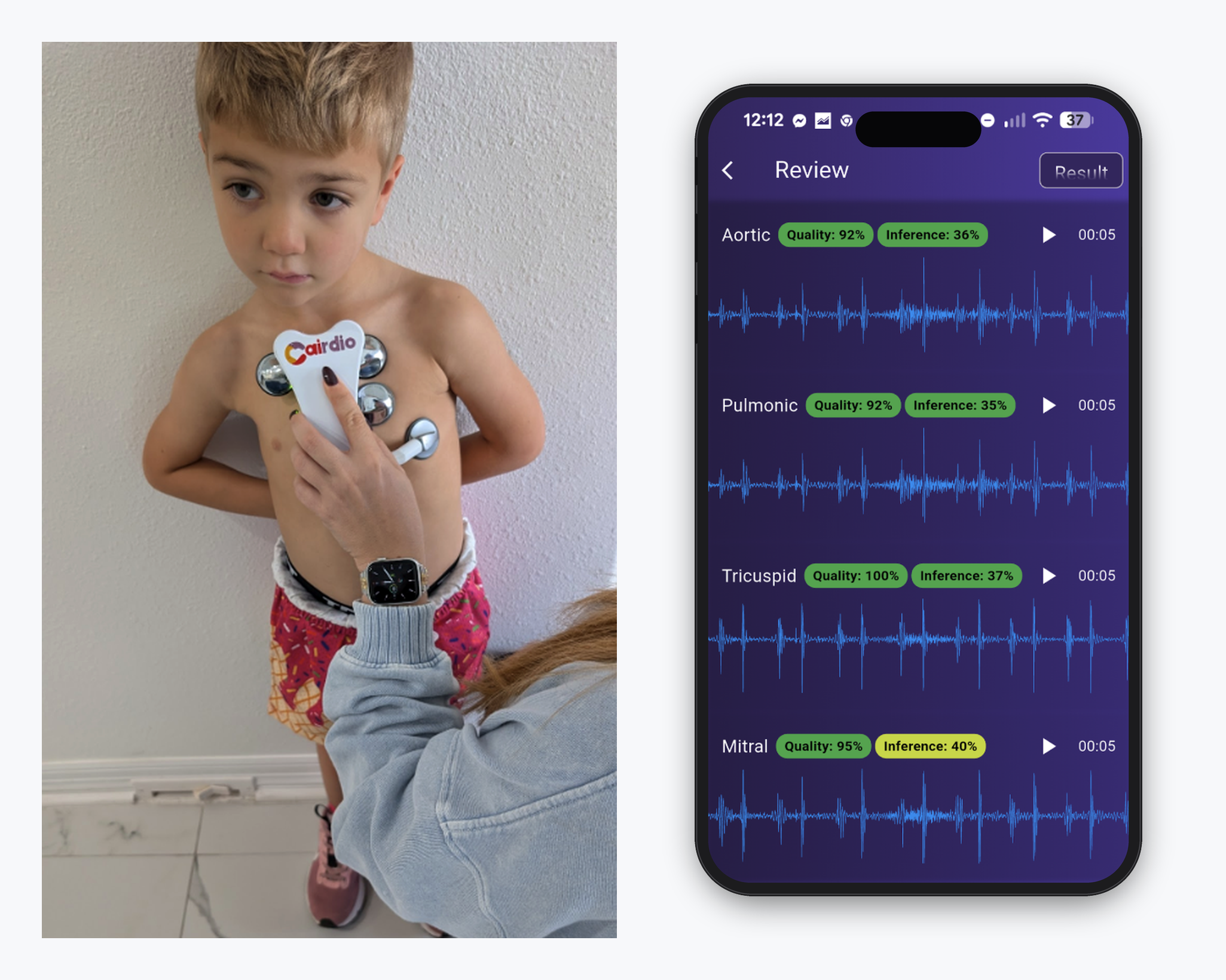
In Use
Cairdio in real-world pediatric use — device placed, four tracks capture heart data in under 10 seconds, AI reviews and displays results instantly on screen.
The diagnostic gap
The stethoscope was invented
in 1816. Hearts haven't changed.
But what we can hear has.
01
The human ear has limits
Traditional auscultation depends entirely on the clinician's hearing, experience, and the acoustic quality of a single stethoscope head at a single point. Subtle, life-altering murmurs fall below the threshold of reliable human detection — especially in fast-paced clinical environments.
02
Pediatric hearts are different
Children's cardiac anatomy produces murmurs that are often softer, shorter, and more easily masked by ambient noise than adult presentations. And because pediatric hearts are still growing, the ability to detect an abnormality can change from one year to the next — a murmur missed at this year's checkup may be catchable at the next. Consistent, repeatable assessment matters here in a way it doesn't for a fully-grown heart.
03
Missed diagnoses compound
A murmur missed in a 6-year-old wellness visit becomes an undiagnosed congenital defect at 16, a cardiac event at 34, and a lifetime of preventable risk. The window for early intervention closes quietly — at the point of care, in seconds, with a tool that couldn't hear it.
04
The risk is real
The risk of sudden cardiac arrest rises with age when an underlying heart condition goes undetected — and survival rates after cardiac arrest can be as low as 10%. Caught early, the same condition means a referral to a cardiologist and a plan of care while every option is still on the table. Left undetected, it can also mean years of reduced performance and quality of life without ever knowing why.
The problem was never clinical skill. It's that no clinician has ever had a reliable way to hear what only a specialist could. Cairdio closes that gap — for every child, at every visit.
What stethoscopes can't do
Four tracks.
Five seconds.
Zero missed beats.
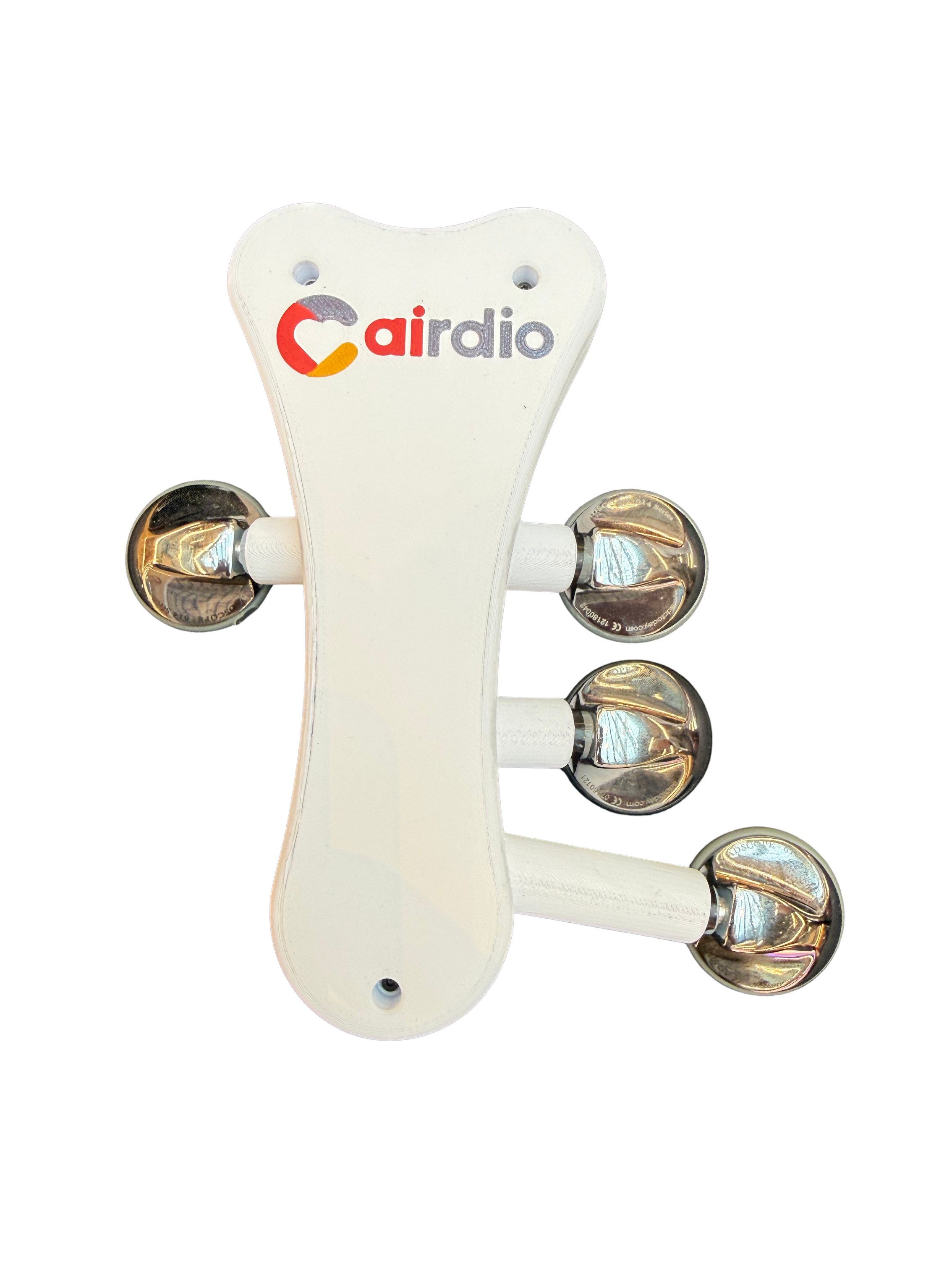
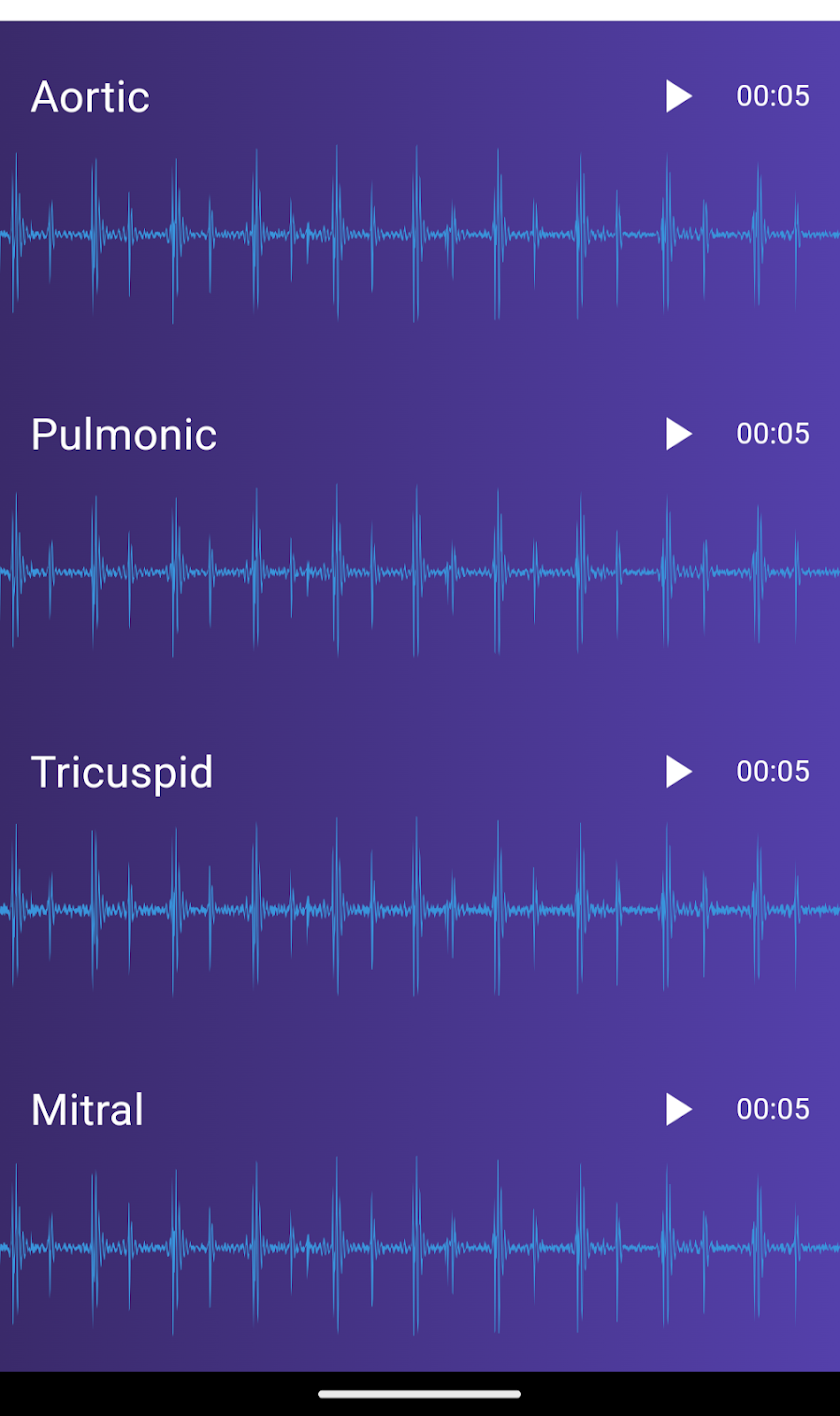
Cairdio's patented 4-track device captures synchronized heart recordings from all four cardiologist-preferred auscultation points simultaneously. No repositioning. No interpretation required at the point of care. Just place, press, and know.
Capture time
5–10 seconds
Auscultation points
4 simultaneous tracks
Training required
None
Form factor
Handheld · portable
AI analysis
Pathology-trained models
Patent status
Granted · 2023
From sternum to diagnosis
Three steps.
One clinical guardian.
1
Place. Press. Done.
Position the Cairdio device on the patient's sternum. The patented design automatically aligns all four stethoscope heads to the cardiologist-preferred auscultation points. Press once. In 5–10 seconds, a complete synchronized 4-track heart recording is captured.
No repositioning between sites. No subjective interpretation at the point of care. Any staff member who can hold the device can perform the risk assessment — no cardiology training required.
2
AI analyzes. Instantly.
The moment the recording finishes, Cairdio's on-device AI analyzes all four tracks instantly — no Wi-Fi required — identifying patterns, flagging anomalies, and surfacing the signals that human ears and single-point stethoscopes routinely miss, right at the point of care.
Once back online, the recording also uploads to Cairdio's secure cloud platform for deeper analysis — including specialized third-party models, like one developed by Rice Nexus. Both are built on Cairdio's own deep learning models, trained specifically on phonocardiogram signals.
3
Refer with evidence.
Clinicians receive a clear, data-backed result — not a subjective judgment call, but an evidence-based finding they can act on with confidence. Refer a patient to a cardiologist with a complete, documented 4-track recording instead of a clinical impression.
Backed and directed by leading cardiologists, including Dr. Asif Ali — a preventive cardiologist and member of the American Heart Association's Center for Health Technology & Innovation (CHTI) Health Tech Advisory Group. Every risk assessment builds the patient's cardiac profile, creating a resourceful trend line that grows more valuable over time.
"People are dying every day because their heart anomalies have not been detected. We offer a simple, inexpensive way to check for such problems."
— Rick Jones, Founding Co-Owner, HealthSeers · Rice University Electrical Engineering Alumni '76
Built for your practice
Every clinician who touches
a child can now assess cardiac risk.
Pediatricians
Turn every well-child visit into a cardiac risk assessment.
Add Cairdio to your wellness exam workflow without adding time or complexity. Catch what routine auscultation misses — and refer with evidence, not instinct.
Nurse Practitioners
Expert-level cardiac risk assessment without specialist training.
Cairdio requires no cardiology background to operate. Any NP who can hold the device can deliver cardiologist-level auscultation data — instantly, at the point of care.
Urgent Care & Walk-In Clinics
Triage serious heart conditions without specialist tools.
Designed specifically for nurse practitioners and healthcare providers in urgent care settings that don't have the equipment or training to assess risk for serious cardiac conditions — until now.
Ready when you are
Hear what you've
been missing.
Request a clinical trial and experience Cairdio in your practice. No commitment. No training required. Just place, press, and listen to what four tracks of AI-analyzed cardiac data sounds like.
Available for pediatric practices across the United States